What Is a Second Brain? A Plain-English Guide
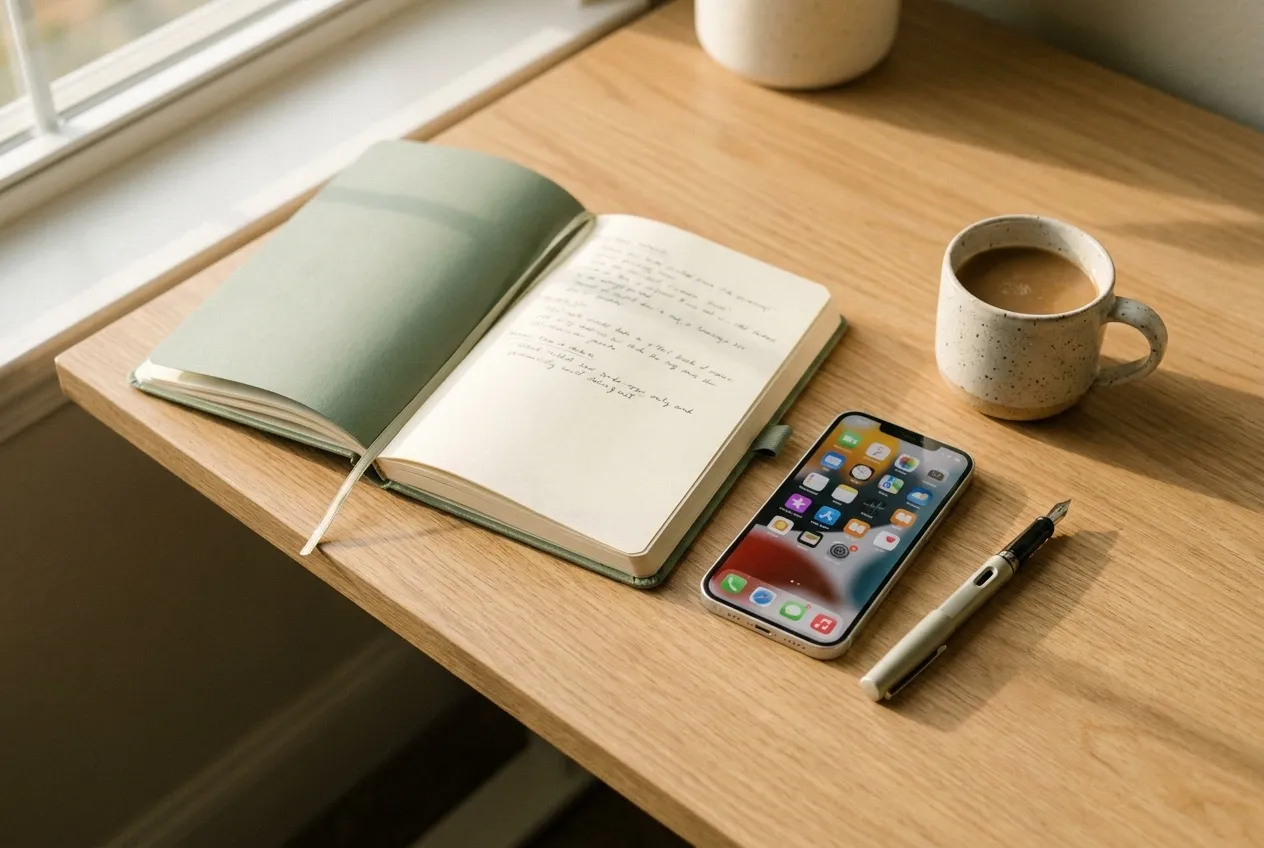
A second brain is a place outside your head where you keep the things you want to remember — ideas, plans, facts about your life, the name of the plumber who actually showed up. The point is not to store everything. The point is to trust that whatever you put in will come back when you ask for it.
That’s the entire concept. Everything else — the books, the methods, the four-letter acronyms — is detail. This guide covers where the term comes from, what belongs in a second brain, what doesn’t, and how to start one this week without rearranging your life.
Where the term comes from
The phrase was popularized by Tiago Forte, whose 2022 book Building a Second Brain turned a course he’d been teaching for years into a method: capture what resonates, organize it by project, distill it down, and express something with it.
The idea is much older than the book. People have kept commonplace books — personal notebooks of quotes, ideas, and observations — since at least the Renaissance. Niklas Luhmann, a German sociologist, wrote 70-odd books with the help of 90,000 index cards he treated as a thinking partner. Philosophers call the general principle the extended mind: tools that hold knowledge for you are, functionally, part of how you think.
So a second brain isn’t a product or an app. It’s a commitment: things I want to keep go there, and there is somewhere I can actually get them back from.
What goes in
Concrete beats abstract here. Things that belong in a second brain:
- Ideas that show up at inconvenient times — in the shower, on the school run, three minutes before a meeting.
- Recommendations: the restaurant a friend swore by, the book your dentist mentioned, the show you’ll want in February.
- Decisions and the reasons behind them, because in six months you’ll remember the decision and not the why.
- Small facts about your own life: where you parked at the airport, which paint color the hallway is, what the mechanic said was about to fail.
- Commitments — the casual “let’s do something in May” kind that calendars never catch.
A useful filter: if a future version of you might ask for it, it goes in. If no version of you will ever ask, it doesn’t need to exist anywhere.
What a second brain is not
It is not a perfect archive of your existence. Trying to capture everything is the fastest way to abandon the whole habit, because the effort outruns the payoff within a week.
It is also not a productivity religion. You don’t need to adopt a workflow with a name, buy a course, or maintain a dashboard. Some people genuinely enjoy gardening their notes for an hour on Sundays. If that’s not you, nothing is wrong with you — the method was supposed to serve the remembering, not the other way around.
And it is not your task manager. To-dos have deadlines and disappear when done. A second brain is the durable stuff: what you know, what you noticed, what you decided.
The forgotten half: getting things back out
Here’s the part most guides skim past. Capture is half the system. Retrieval is the entire point.
A second brain you can’t query is a junk drawer with a nicer name. And most note collections quietly become exactly that — write-only archives, added to daily and read never. I’ve written about why notes never get looked at again, but the short version: if finding a note requires remembering that you wrote it, what you titled it, and which folder you filed it in, you’ve just moved the memory problem one level up.
When you evaluate any second-brain setup — app, notebook, whatever — test the way out, not the way in. Put ten things into it, wait three days, and try to retrieve three of them. That test tells you more than any feature list.
Do you need special software?
No. A paper notebook with a habit of rereading it is a real second brain — slow, but real. Apple Notes works fine if folders and keyword search don’t bother you. Power tools like Notion and Obsidian work well if you’ll genuinely maintain the structure they need; they reward the kind of person who enjoys maintaining structure.
What actually matters is three properties:
- Capture is fast. A thought should be saved in seconds, or it won’t be saved at all.
- Everything is in one place. Two systems means deciding, every time, which one — and deciding is friction.
- You trust the way back. Search that works the way memory works: by meaning, roughly, not by exact wording.
Full disclosure: I’m biased on this question. I built Second Brain — an app named after the concept, and my honest attempt at the best second brain app you can carry in a pocket. It’s shaped like a chat thread: you text thoughts in, an AI turns them into smart notes and lists on its own, and later you ask for them back in plain language. I built it because I kept texting myself things and losing them in my own chat history. The three properties above are still tool-agnostic; judge anything, including my app, against them.
How to start this week
Skip the template-shopping phase entirely. It’s where second-brain projects go to die.
- Pick one place. Whatever you’ll actually open. The best system is the one that’s already on your phone.
- Put ten real things in. Not test notes — actual things you’d hate to lose. The electrician’s name. The idea from the shower. What your daughter said about her new teacher.
- Three days later, try to get three back. This is the honest test. If retrieval feels like work, the system will quietly die; change the system, not your discipline.
- Cut capture friction to near zero. Lock-screen widget, voice notes for when your hands are busy, no titles, no filing.
- Don’t schedule maintenance. If the system needs weekly tending to stay useful, it’s a hobby. Fine if you want a hobby — but remembering shouldn’t require one.
That’s it. No folders to design, no method to study. A second brain starts the moment you put one thought somewhere you trust — and ask for it back.