Can AI Organize Your Notes for You? What to Expect
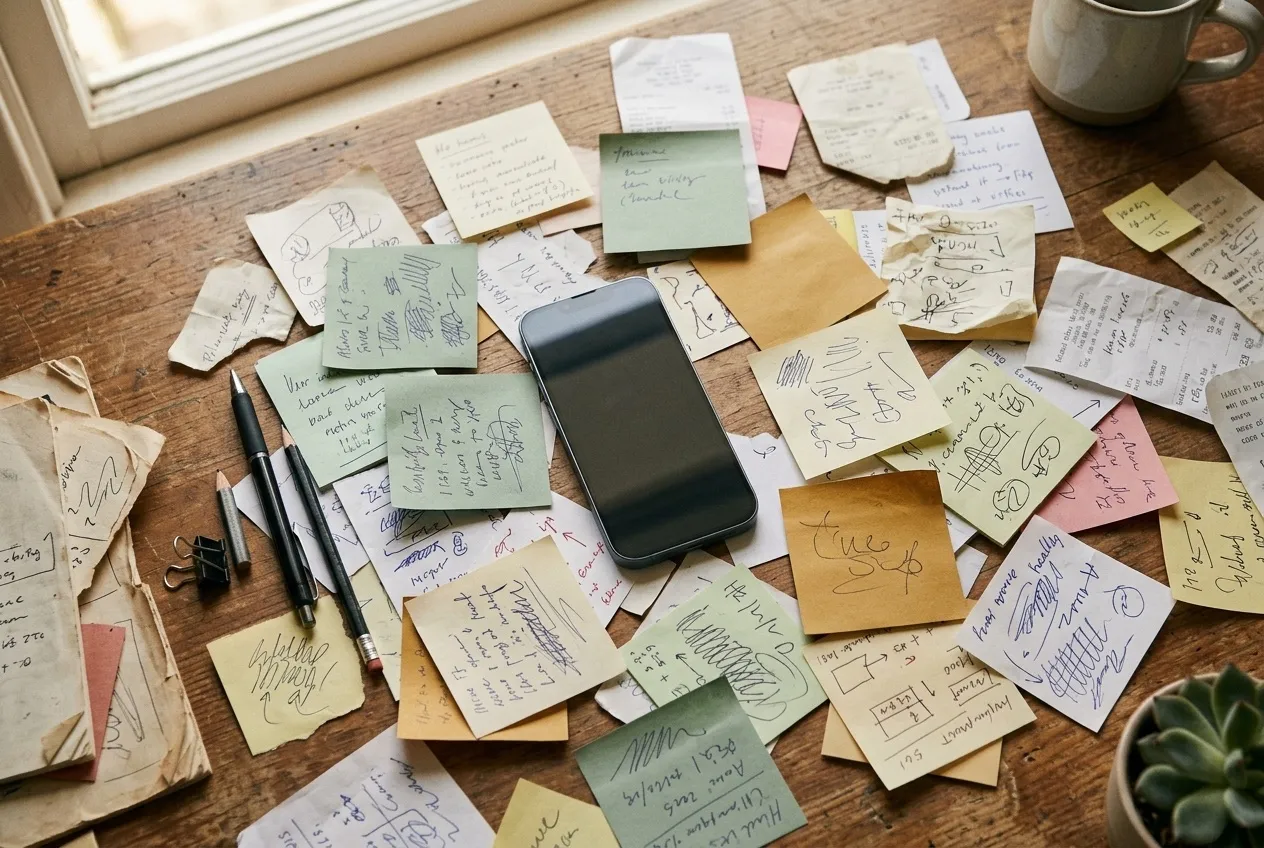
Yes, AI can organize your notes — genuinely, today, without you lifting a finger. What it can do well: classify what a note is, extract the to-dos and dates buried inside it, summarize rambles, and make everything findable by meaning. What it can’t do: read your mind. The difference between those two sentences is what this post is about.
The junk-drawer confession
First, absolution: everyone’s notes are a mess. The folder enthusiasts’ notes are a mess with folders. Surveys of actual note archives — and every honest person’s self-audit — show the same picture: duplicates, fragments (“blue one!!”), screenshots with no context, a shopping list embedded in a meeting note.
This mess is not a discipline failure. It’s what capture should look like, because capturing fast means capturing messy. The mistake of the last twenty years of note apps was making the human clean it up. The premise of AI organization — of “smart notes,” to use the term honestly — is that the mess stays cheap to make and software pays the cleanup cost.
What AI can genuinely do today
Concretely, current AI handles four organizing jobs well:
- Classification. Is this a note, a task, a journal entry, a shopping item? “Buy AA batteries” and “felt really good after the run” should not be filed the same way — and don’t have to be.
- Extraction. The date inside “dentist moved it to the 14th,” the action inside a paragraph of venting, the three items inside one rambling sentence — pulled out and turned into real list entries and reminders.
- Summarization. A two-minute voice ramble has about one sentence of payload. AI is reliably good at finding it.
- Semantic indexing. The invisible one that matters most: notes become findable by meaning, so “oil change” finds “car service.” Filing exists for the sake of finding; if finding works without filing, most filing can simply not happen.
A worked example
One real-shaped note: “Okay so Veli came by, quoted nine thousand for the bathroom but only until end of June, also need to ask Selin about the tile color, and we’re out of filter coffee.”
A capable system makes of that: a note about the bathroom renovation containing the quote; a reminder shaped by the deadline; “ask Selin — tile color” as a to-do; filter coffee on the shopping list. Four useful objects out of one breath. You did nothing but talk.
Where it still gets it wrong — and why the override matters
Honesty section. AI mis-sorts things. It will occasionally read your sarcastic “great, another meeting” as a calendar-worthy event, miss that “the blue one” refers to the lamp from yesterday’s note, or extract a “to-do” you never intended to do. Ambiguity is genuinely hard, and your notes are private shorthand — the most ambiguous text there is.
Two consequences. First, any app doing this must make corrections one-tap easy; an AI that’s wrong and stubborn is worse than a folder. Second, expect a calibration period: the first week you’ll fix a handful of things, and it should learn the shape of your life from your corrections — who Selin is, what “the site” means. If an app’s mistakes don’t decrease, that’s a verdict.
The question to ask before trusting it
One more thing belongs in the evaluation, and it isn’t a feature: AI organization means your notes are processed by AI — usually in the cloud. That’s a privacy deal, and it deserves the same five-minute check I’d apply to any AI journal: who processes the text, does anything train on it, can you delete everything. An app that organizes brilliantly but won’t answer those plainly hasn’t earned the junk drawer’s contents.
How to try it without migrating your life
Don’t move four thousand old notes anywhere — migration is how these experiments die. Run a two-week trial forward instead: pick an app (mine, Second Brain, works like a chat — biased recommendation, obviously), and for two weeks capture everything new into it, as messily as real life produces it. No tidying, no titles.
Then grade it on two questions only. Did the filing actually happen without you? And could you find things by asking, weeks later, in your own lazy words? If yes to both, you’ve seen what smart notes are for — and the junk drawer was never your fault.