How to Remember Ideas Before They Disappear

The only reliable way to remember an idea is to get it out of your head within seconds, into one place you always use. Everything else — repeating it to yourself, promising you’ll write it down later — loses to the next distraction, almost every time.
The fix isn’t a better memory. It’s a faster pipe.
The thirty-second window
Psychologists have measured how quickly unrehearsed thoughts fade, and the classic experiments put it at under thirty seconds once your attention moves on. An idea isn’t a file sitting in your head waiting to be saved; it’s a pattern you’re actively holding, and the moment something else needs the same machinery — a doorbell, a Slack ping, a child asking for a snack — the pattern is gone.
Worse, ideas tend to arrive precisely when you can’t deal with them: mid-shower, mid-drive, mid-conversation. The arrival conditions and the capture conditions almost never overlap. That’s the actual problem to solve.
Count the taps
Here’s an audit worth doing once: take your current capture method and count every step between idea and saved.
Pull out the phone. Unlock. Find the app. Open it. Tap new note. Stare at the title field. Decide a title. Decide a folder. Type. Save. That’s a realistic eight to ten steps in many setups — and every single step is a chance for the idea to evaporate or for you to decide it wasn’t worth the trouble.
Now cut ruthlessly. Lock-screen widget instead of hunting icons. An app that opens straight into an input box instead of a menu. No titles, no folders, no decisions. The honest target is under five seconds from pocket to saved. Past that threshold, capture starts losing to “I’ll remember it” — and you won’t.
Voice first when your hands are busy
Speaking is the fastest capture there is. Most people talk at around 150 words a minute and thumb-type at a small fraction of that — and talking works while you’re walking, cooking, or carrying groceries up the stairs.
A voice note also captures things text flattens: the half-formed shape of an idea, the hesitation, the “no wait, actually—” that turns out to be the good part. You’re thinking out loud and saving the thinking.
The catch — and it’s a real one — is that raw recordings are where ideas go to hibernate. Nobody re-listens to voice memos. If voice is going to be your capture lane, the recording has to become text you can search, automatically, without a transcription chore bolted on. That’s the difference between voice notes that become real, findable notes and a graveyard of M4A files with timestamps for names.
One safety note: if you’re driving, it’s hands-free voice or nothing. No idea is worth it.
One inbox, zero decisions
The second friction killer, after speed: stop deciding where things go.
Every “where does this belong?” moment costs more than the seconds it takes. It makes capture feel like work, and anything that feels like work gets skipped when you’re busy — which is exactly when the good ideas show up. The people who capture the most reliably all converge on the same pattern: one inbox, everything goes in, sorting is not the capturer’s job.
Let the sorting happen later, or better, let software do it. When a note that says “buy AA batteries and call the accountant before Thursday” can become a list item and a reminder on its own, the filing question stops existing.
The hard cases
The shower. Compress the idea to one anchor phrase and say it out loud a couple of times — out loud matters — then capture the moment you’re out, before the towel. The anchor usually unfolds back into the full idea; give it first priority over checking notifications.
Mid-conversation. Capturing openly is almost always fine: “hang on, I’m writing that down” is a compliment. A one-line note now beats a perfect note never.
3 a.m. Keep the phone (or a pad) within arm’s reach and write the one line in the dark. Do not negotiate with the voice saying you’ll remember it at breakfast. The 3 a.m. version of you is a stranger who leaves no forwarding address.
Captured isn’t remembered
A caught idea that never resurfaces is only half-saved. The capture habit pays off when the idea comes back at the moment you need it — when “that gift idea for Deniz” reappears in November, not in some someday-review of an inbox folder.
So judge your capture system by its other end: can you find things by asking roughly, the way memory actually works, months later? If the answer is no, you’ve built a very fast pipe into a very dark cellar. That retrieval side has its own failure modes and fixes, and it’s worth getting right before the archive grows.
What I actually use
I’m the developer of a notes app, so discount accordingly — but the setup is simple enough to describe in one paragraph. Everything goes into a single chat thread: typed one-liners when my hands are free, voice notes when they aren’t, photos when the thing is the note. No titles, no folders, ever. The app turns the mess into smart notes on its own — transcribes the voice, files what’s file-able into lists and reminders — and later I just ask, “what was that idea about the onboarding screen?”, and it comes back.
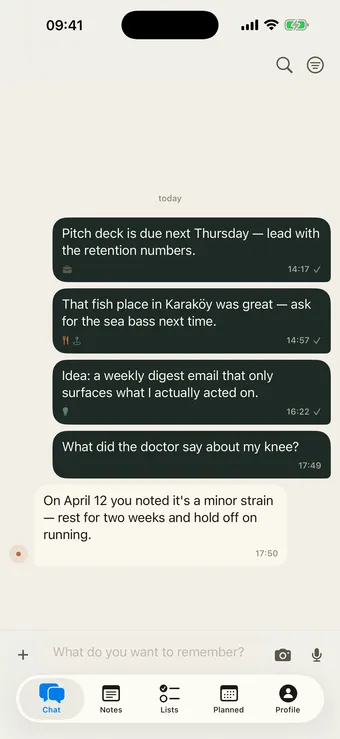
Whatever tool you choose, the principles transfer: seconds-fast capture, voice for busy hands, one inbox, retrieval you can trust. If your head is so full right now that single ideas aren’t the problem, start with a ten-minute brain dump instead — then set up the pipe.